简体中文
 English
Compacted vs Sealed vs Filler: Three 6x19 Constructions Compared
All called 6x19, yet metallic area, surface and corrosion life differ
What the three 6x19 ropes share
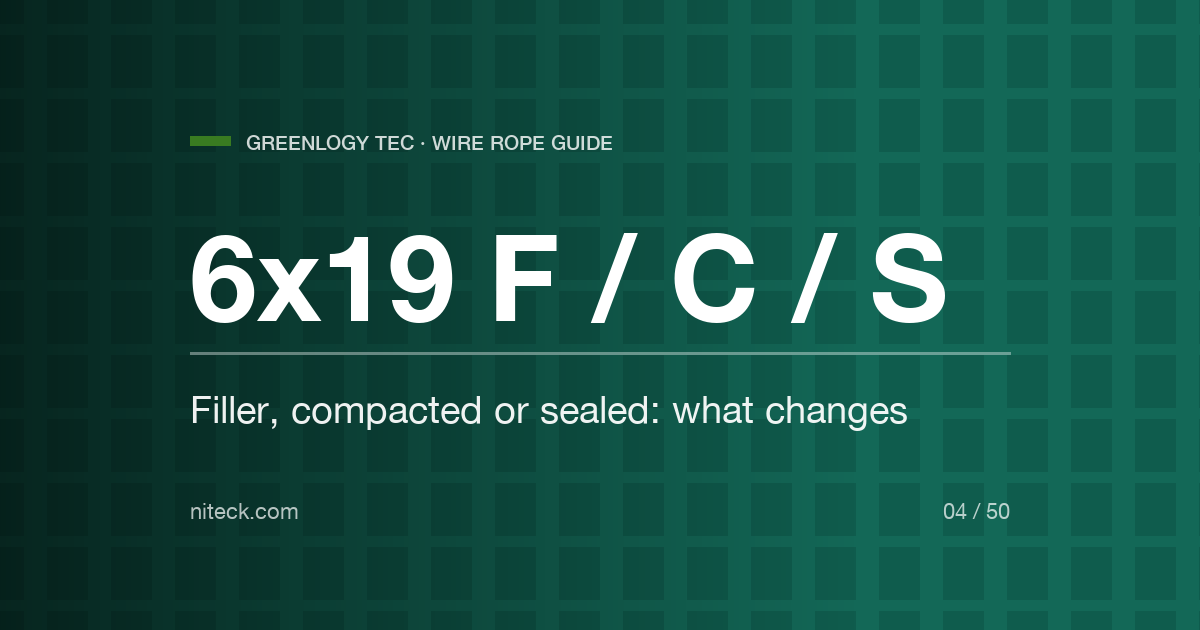
Filler, compacted and sealed ropes are all commonly written as 6x19: six strands of nineteen wires. They can share the same diameter, lay and core, but the strand shape and surface differ, and so do life and service environment.
Do not assume a 6x19 can be swapped for another 6x19. Filler, compacted and sealed versions differ in metallic area, surface smoothness and corrosion resistance.
The nineteen in 6x19 is wires per strand, not rope diameter. A 6x19 can run from a few millimetres to tens of millimetres, with different wire sizes and cores. An order that gives only the construction leaves the supplier unable to judge load and bending, so diameter and duty must be stated as well.
Filler strand 6x19F
Filler strand adds fine filler wires between the main wires so the strand is rounder and tighter. It is relatively simple to make, costs less, balances bending and abrasion, and is a common choice for general lifting and stay ropes.
The surface still has grooves between strands where water and dirt can enter. It is adequate indoors or in ordinary industrial environments; wet or corrosive sites need additional protection.
The number and placement of filler wires affect strand roundness. Good filling gives more even strand-to-strand contact and a stable diameter; too little lets strands deform and the rope run unevenly on sheaves. Two makers' 6x19F ropes can look alike while their filler design differs.
Compacted strand 6x19C
Compacted strand is pressed or drawn after laying, closing the gaps between wires. At the same diameter it carries more metallic area, gives higher breaking force and has a smoother surface.
The smooth surface spreads contact with the sheave groove more evenly, usually improving abrasion and bending fatigue. The rope is stiffer, may need a larger minimum sheave, and the termination must match the actual diameter.
Compaction changes final diameter and surface hardness. A compacted rope at the same nominal diameter may measure slightly smaller, so sheave grooves and swaged fittings must match the actual diameter. Using an ordinary 6x19 fitting on a compacted rope can give insufficient grip or crush the wires.
Sealed strand 6x19S
Sealed strand uses shaped outer wires that lock together and close the rope surface. Water and dust have less chance to enter, which suits coastal, mining, chemical and long-term outdoor exposure.
Sealed rope is complex to make, costs more and demands careful termination. It is not simply an upgraded compacted rope; the extra cost buys sealing and corrosion resistance. Decide by environment, not by price.
The shaped surface of a sealed rope also retains grease. A smooth closed surface limits water ingress and stops grease being squeezed out, but if water enters at the terminal the inside can still corrode. Sealed rope is not maintenance-free; end sealing and periodic inspection are still needed.
Load and service life
At the same diameter, compacted and sealed ropes usually have more metallic area and higher breaking force than filler rope. Breaking force is not the only measure: bending fatigue, abrasion, corrosion resistance and termination efficiency all affect real life.
Filler rope is economical for general duty; compacted rope suits combined load and wear; sealed rope suits severe corrosion and hard-to-maintain sites. Choose the wrong type and the rope may fail from environment or fatigue rather than calculated load.
Life also depends on sheave and drum matching. A compacted rope is stiffer, so bending stress may rise if the sheave is unchanged; a sealed rope has a smooth surface but complex terminals, and termination efficiency can become the weak point. Treat rope, sheave and terminal as one system.
The three strand types may also differ in weight. More metallic area makes a rope of the same diameter heavier, so drum and support loads must be rechecked. When changing strand type, compare weight and actual diameter as well as breaking force.
Lubrication also changes the life of all three types. Filler rope grooves collect dirt, compacted rope has a smooth but thin oil film, and sealed rope relies on end sealing and initial lubrication. Whatever the strand type, set first lubrication and relubrication intervals by the duty; in dusty, washdown or hot areas, shorten the interval and record the amount added, diameter change and broken-wire locations. A continuous record shows the wear trend better than a single inspection and helps decide whether to replace the rope early.
How to choose
Start with the environment: filler indoors, compacted for moisture, dust and wear, sealed for coastal, chemical and long outdoor exposure. Then check bending: with small sheaves and frequent bending, confirm the stiffness of a compacted rope.
Finally check the termination: strand surface and diameter affect swaged and wedge fittings. If termination efficiency is low, even a strong rope cannot deliver its full strength.
The differences between the three constructions are set out in the wire rope construction guide
- Dry indoor, general lifting: 6x19F is economical and adequate.
- Damp, dusty, abrasive: 6x19C gives a smoother surface and higher load.
- Coastal, chemical, long outdoor exposure: 6x19S solves sealing first.
- Limited terminal space: confirm fittings match the measured diameter.
Ordering points
State the exact 6x19 type on the order: F, C or S, plus core, lay, strength grade, surface, length and termination. Write only 6x19 and the supplier may ship stock, leaving you with the wrong strand type on site.
To compare published breaking forces, see the wire rope breaking strength guide
Core options are explained in the wire rope core types guide
If certificates are required, state the standard, guaranteed breaking force, tests and traceability. Filler, compacted and sealed ropes may be supplied to different standards, so do not compare quotations on 6x19 alone. Packing and rust-preventive oil should also be specified, especially for sea freight and long storage.
One-line rule
Use filler for general duty, compacted where load and wear combine, and sealed where corrosion is severe. All three are called 6x19, but they are not interchangeable. Writing the strand type in full on the order is cheaper than replacing the rope later.