简体中文
 English

Wire Rope Discard Criteria: Wires, Wear and Corrosion
Each defect under its limit is not safety; defects combine and records must show trends
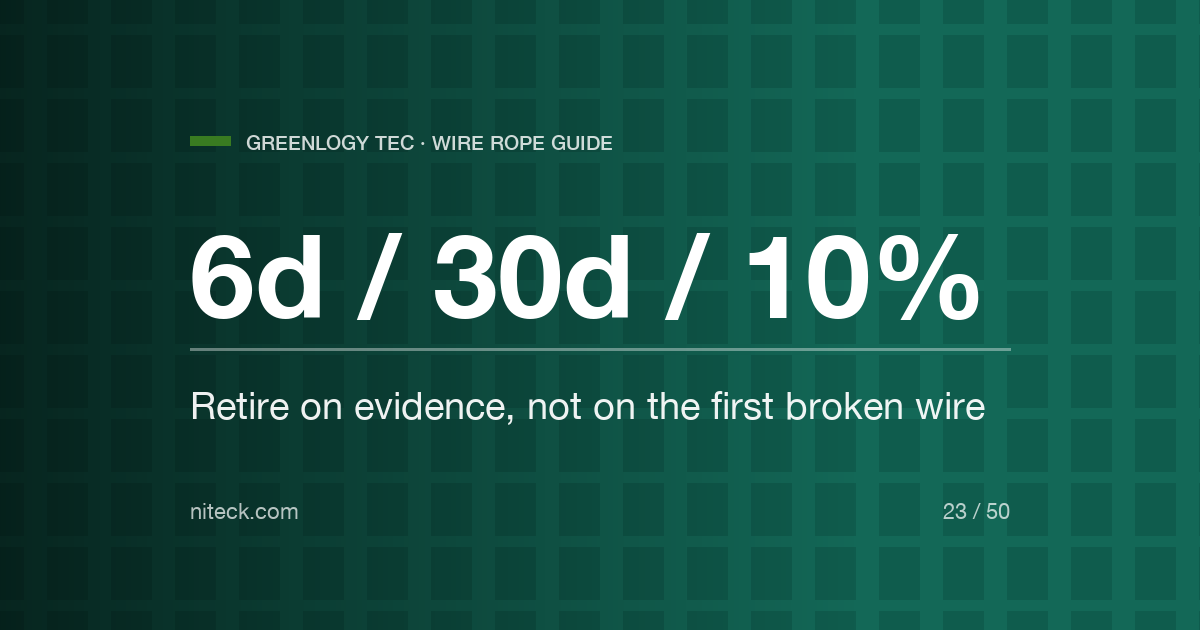
Discard is not about the first broken wire
The point of a discard decision is how much safety margin is left, not whether a wire has broken. Broken wires, wear, corrosion and deformation all reduce the effective load-bearing section, and when any one approaches its limit the rope should come out of load service.
The basis is usually the rope inspection standard for the equipment, such as ISO 4309 and related documents, plus the machine maker's instructions. Limits differ with equipment, rope type and duty, and one table cannot cover every case.
Discard is not a one-off judgement either. A baseline is needed when the rope enters service: measured diameter, initial broken wires, lubrication state and installation position. Without a baseline, later changes cannot be quantified.
Counting broken wires
Count visible broken wires on the outer surface and record them by distribution length. Common counting lengths are one lay, six rope diameters and thirty rope diameters; the standard gives allowable counts for each, by rope type, and exceeding them means discard or downgrade.
Distribution matters more than the total. Ten broken wires in one short length are far worse than ten spread over tens of metres, and concentration near a termination, at a sheave that bends the rope repeatedly, or on the groove contact face deserves extra attention.
Broken wires occur at crowns and in valleys. Crown breaks sit on the top of a strand and are easy to see; valley breaks hide between strands and are easily missed. Turn the rope as you inspect and use a magnifier and your fingers, not one view.
Internal breaks cannot be seen but leave signs: a local increase in diameter, a stiffer rope, an odd feel in bending, grease pushed out. On critical duty, non-destructive testing such as the electromagnetic method can help, with results read by an experienced person.
Wear and diameter loss
Wear happens where the rope meets the groove and the guides. Outer wires flatten, individual wire diameter falls and the metallic section of the whole rope shrinks. With even wear, diameter loss is the visible indicator.
Measure diameter at fixed positions and in fixed directions. Mark several points when the rope is installed and measure the same points in the same direction each time, then compare the trend. A single normal reading does not prove wear is slow.
Local wear is more dangerous than even wear. A rope that is loaded repeatedly at one sheave develops a distinct flat or neck; the local defect must not be hidden by an average diameter for the whole rope.
Look at individual wires as well as diameter. Losing a third of the wire diameter, even with little change in rope diameter, means the capacity at that point has already fallen significantly.
Corrosion
Corrosion is external and internal. External corrosion is visible: a dull surface, flaking, rust pits. Internal corrosion is not; it can only be inferred from diameter change, grease condition and the state of the core.
Corrosion damages capacity more than wear of the same visible depth, because pits concentrate stress and accelerate fatigue cracking. Dense pitting, wires that snap when bent by hand, or an exposed and rusted core all call for immediate discard.
Grease condition is the signal for internal corrosion. Dried, emulsified or discoloured grease, or rusty water squeezed from between strands, shows that water has reached the core and internal corrosion may have started.
On galvanized rope, corrosion works on the zinc until the coating is used up; after that the steel corrodes faster. Marine and chemical sites need shorter inspection intervals than inland experience would suggest.
Deformation and heat damage
Deformation includes kinks, opened strands, bird-caging, core protrusion, local increase in diameter, crushing, bends and loops. These create permanent stress concentrations, cannot be repaired and mean replacement.
A kink is the most common and the most underrated. A loop forms under torsion and leaves a permanent bend when pulled straight; the wires there have yielded and their capacity is much reduced.
Heat damage includes flame, welding spatter, lightning strike and hot work nearby. Heated wires change colour and lose strength, grease burns away, and the discoloured zone may have lost far more strength than the eye can judge.
There is no reliable field repair for heat damage. If a rope may have been overheated or struck by current, treat it as discarded; looking serviceable is not evidence.
How defects combine
Real discard decisions rarely face one defect alone. Broken wires, wear and corrosion usually coexist and feed each other: wear opens the surface, corrosion enters the worn track, corrosion cuts section and fatigue cracks start more easily.
The single-item limits in a standard assume the other items are acceptable. If two items are both near their limits, replace early even though neither has passed it; every item being individually under the limit does not make the rope safe.
A sounder engineering approach is to assess loss of metallic area: convert broken wires, wear and corrosion into section loss and compare the total with the allowable value. The remaining capacity is then checked against the original guaranteed breaking force, published in the wire rope breaking strength data
Deformation and heat damage are not part of that conversion; they are veto items. Once either is present, the rope is replaced regardless of how few wires have broken.
Inspection records and intervals
The interval follows usage, load character, environment and the rate at which the rope wears. Frequent lifting, heavy load, corrosive sites and high temperature shorten it; low utilisation and a dry site allow longer, but the first inspection should not be delayed too far.
Record the date, rope number and position, accumulated working hours, measured diameter at fixed points, broken wire counts and positions, a description of wear and corrosion, lubrication state, photographs and the inspector.
Trends beat single readings. Losing 0.1 mm a month and losing 0.1 mm in six months mean very different things; the record must show the rate of change, not just the word normal.
Record installation, re-termination and end changes too. A rope on one machine may have had a section replaced, and a broken history removes the basis for judging it.
Replacement decisions and data checks
When a rope is discarded, the replacement must match the original design: construction, diameter, core, lay, strength grade, finish and termination. Buying by diameter alone is the commonest substitution error.
Check the guaranteed breaking force of the new rope, not just its diameter. At one diameter, different constructions and grades differ widely in breaking force; a machine designed for one grade loses margin when a lower grade is fitted.
- Construction and diameter: full code, nominal diameter and tolerance.
- Core and lay: match the original rope, and confirm any change.
- Grade and guaranteed breaking force: check against the original design grade.
- Finish and termination: coating class or steel grade, terminal type and efficiency.
To confirm what a construction code means before ordering, use the wire rope construction guide
For full dimensional and test data to compare against the record, see the steel wire rope technical data