
 简体中文
 English
Wire Rope Sling Angles and Leg Loads
Every degree of spread adds leg tension and removes margin
Which angle we mean
Sling angle can mean two things: the angle between the two legs, and the angle each leg makes with the vertical. Tables often use the first, calculations usually use the second, and one is half the other; mixing them doubles or halves the result.
Unless stated otherwise, the angle in this article is the included angle between the legs. With two symmetric legs, each leg sits at half that angle from the vertical.
Do not judge the angle by eye on site. The angle changes once the sling is loaded: measured empty before the lift, the legs close in as the load comes off the ground, the included angle grows and the leg loads grow with it. Longer legs change angle less for the same horizontal offset, so long legs are steadier at a wide angle.
Calculating the load in one leg
With two symmetric legs and a centred load, each leg carries half the vertical load. Once the leg is inclined, the tension equals the vertical share divided by the cosine of half the included angle: T = W / (2 cos(θ/2)).
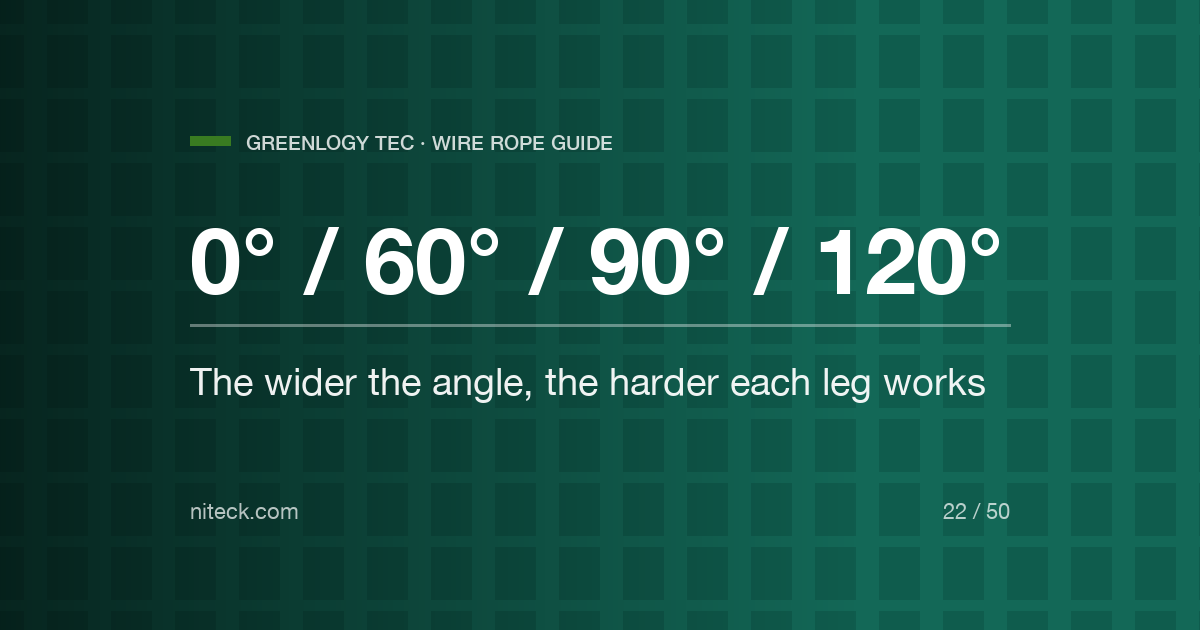
In other words, the wider the angle, the smaller the cosine and the higher the tension. At 60 degrees each leg carries about 0.58 of the total load, at 90 degrees about 0.71, and at 120 degrees exactly 1.0.
This is static equilibrium only. It excludes the dynamic factor, off-centre loads, knot efficiency and termination efficiency. In real selection, multiply the calculated tension by the dynamic factor before comparing it with the breaking force. Use degrees for the angle and set the cosine function to degrees, not radians.
Multipliers for common angles
Turning the formula into a multiplier table makes it easier on site. The multiplier is each leg's tension as a fraction of the total load, not of half the load, so read the definition before using a chart.
- 30 degrees: about 0.52 W per leg, close to a vertical lift.
- 60 degrees: about 0.58 W per leg, the most common two-leg angle.
- 90 degrees: about 0.71 W per leg, with horizontal force now significant.
- 120 degrees: 1.00 W per leg, each leg carrying the whole load.
- Above 120 degrees: the multiplier keeps rising and most standards give no rating.
The table makes one point clear: going from 60 to 120 degrees nearly doubles the load in each leg. The sling has not changed and the load has not changed; the legs are simply spread wider, and half the safety margin is gone. The multipliers apply only to a symmetric, static two-leg lift; other arrangements need their own calculation.
If the site can only use a wide angle, the right answer is a larger rope, more legs or different lifting points, not the same rigging pushed further.
Why the limit is usually 120 degrees
Above 120 degrees the tension in each leg exceeds the total load, and the horizontal force the legs impose on the load rises quickly. On thin-walled, easily distorted or surface-sensitive equipment, that horizontal force may cause damage first.
Most sling standards and rigging ratings are tabulated for leg angles of 0 to 45 degrees and 45 to 60 degrees from the vertical, which correspond to included angles of 0 to 90 and 90 to 120 degrees. Wider arrangements normally need a specific assessment and cannot use the standard rating.
Stability is the other issue. At a wide angle the horizontal components squeeze the load inward, and a small shift of the centre of gravity can make it slide or roll, especially with long slender items. If work at a wide angle cannot be avoided, state the actual leg loads and the rigging derating in the plan, and have the site follow it.
Asymmetric lifts
When the centre of gravity is not in the middle, the two legs do not carry equal load. The leg nearer the centre carries the larger share, and splitting the load in half underestimates it.
A sound conservative method is to distribute the load by centre of gravity position and design for the most heavily loaded leg; if the centre is uncertain, check one leg for the whole load, which is conservative but never misses the worst case.
Four-leg lifts are worse. In theory four legs share equally, but in practice the centre of gravity and small length differences concentrate load on two or three legs. Practice often estimates three legs sharing, or calculates the two worst legs, as the governing standard requires. Whichever leg count is used, watch the legs during the lift; if they are unevenly tight, adjust the lifting points or add a spreader beam.
Edges, protection and tag lines
Angle is only part of the load. Where a sling passes over a sharp edge the bend radius is small, outer wires see high local stress, and the breaking force must be discounted. Corner protectors, sleeves or soft slings restore part of that loss.
A tag line controls rotation and swing; it does not carry vertical load. Its pull needs separate consideration, and its attachment must not change the direction of force in the main sling. The tag line operator stands outside the swing zone, and the line is never wrapped around a hand.
Shock is often overlooked. Breaking the load off the ground, a sudden stop or a swinging load all produce momentary peaks; choose the dynamic factor for the duty instead of assuming a slow lift has no shock.
From leg load back to rope diameter
Once the maximum leg tension is known, multiply by the dynamic factor and the safety factor to get the required breaking force, then work back to diameter through the K factor. This is the same calculation as estimating from tonnes, with the leg tension as the load. If the rope runs through a block, divide the load by the number of parts and allow for the efficiency loss at each sheave.
The bending at both ends also needs checking: shackle, hook and thimble sizes set the bend radius, and termination efficiency sets how much of the breaking force is actually available. A weak end wastes a thick rope.
To compare guaranteed breaking forces by construction, see the wire rope breaking strength table
Pre-lift check list
Before the lift, confirm the actual included angle, the weight and centre of gravity, the number and length of legs, the connection at each lifting point, edge protection, tag line position and the dynamic duty. If any item differs from the plan, recalculate. A change of plan, load or rigging needs a fresh confirmation; the previous shift's briefing does not carry over.
Sling ratings are given for a particular termination and a particular angle; shortening, re-terminating or changing a shackle changes the rating. Modified rigging cannot keep its original tag.
To screen sling sizes against leg tension and angle, use the wire rope selector
For a project-specific plan and quotation, send a wire rope sling inquiry